
The Complete Guide to Mercedes-Benz G-Class Restoration: Everything You Need to Know
Some vehicles get repaired. The G-Class gets restored.
That distinction matters. A repair addresses what’s wrong. A restoration starts from a different question: what should this vehicle be? It takes into account the whole picture – not just the fault on the diagnostics screen, but the frame condition, the drivetrain history, the bodywork, the interior, the wiring, the decades of accumulated wear that don’t show up in a single inspection point. It asks not just whether the vehicle runs, but whether it’s everything it was supposed to be.
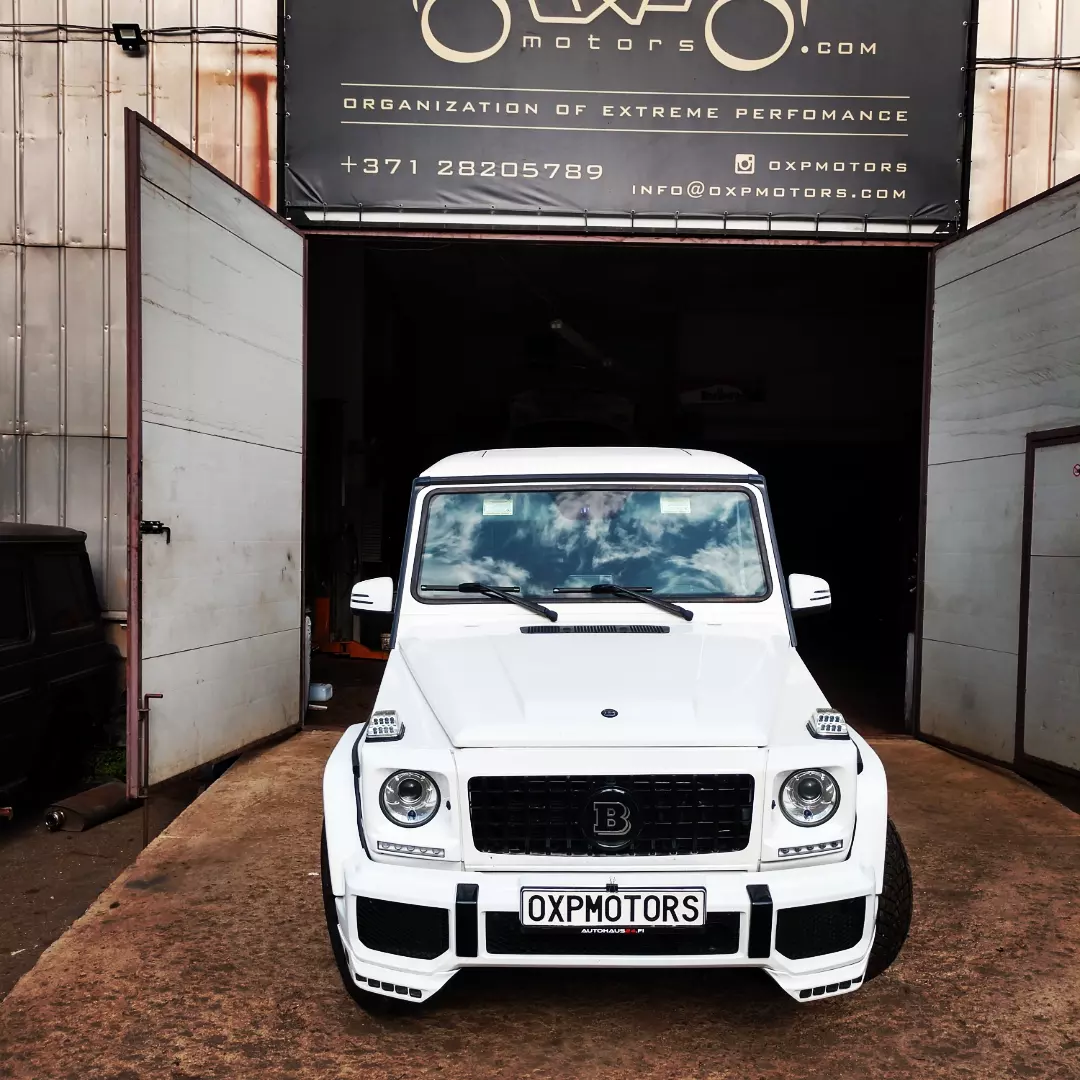
At OXPmotors in Riga, that question is one we take seriously. The G-Class is not a sideline for us – it is the reason the workshop exists. This is the most complete guide to G-Class restoration we know how to write, and it is based on years of working on these vehicles, not reading about them.
Why the G-Class Is Worth Restoring
Before getting into process, it’s worth being clear about why the G-Class occupies a different category from other vehicles when it comes to restoration decisions.
The Mercedes-Benz G-Class – the Geländewagen, the G-Wagen, the “cube” as it’s known to those who’ve owned one long enough – has been in continuous production in recognisable form since 1979. The W460 generation ran until 1991. The W463 ran from 1989 to 2018. These are not vintage curiosities. They are working vehicles with a genuine mechanical philosophy built into them: ladder frame construction, three locking differentials, solid axles front and rear, engines designed to be serviced and rebuilt rather than discarded.
That philosophy is exactly why a G-Class restoration makes sense in a way that doesn’t apply to most modern vehicles. The platform rewards proper work. A G-Wagen that has been fully restored – frame attended to, drivetrain rebuilt, body treated and painted correctly, interior finished properly – will outperform in reliability and longevity most vehicles that left the factory ten years later. That is not a sentimental argument. It is a structural one.
The W460 production run ended over thirty years ago. There is no new supply of these vehicles. Every well-restored example that goes back on the road is one that would otherwise be lost. The same arithmetic is beginning to apply to early W463s. The window for finding good donor vehicles, sourcing OEM parts, and restoring these trucks properly is open now. It is not open indefinitely.
The Scope of a G-Class Restoration: What’s Actually Involved
The reality of what a G-Class restoration involves is usually a more complete picture than the symptom that prompted the initial conversation. A proper G-Class restoration moves through a sequence where each phase informs the next – doing things out of order costs time, money, and sometimes work that has to be done twice.
Phase 1: Complete Assessment
Everything starts here, and no meaningful plan can exist before it is done.
The vehicle comes off the road and onto the lift. A thorough assessment covers the full picture from the bottom up: frame rails, spring mounts, shock absorber cups, sill sections, floor pans, the underside of the windscreen frame, differential casings, transfer case, propshafts, brake lines, fuel lines. On a W460 that has lived in Northern or Eastern Europe, this phase routinely surfaces structural issues that weren’t visible from the outside and weren’t part of anyone’s expectations when the vehicle arrived.
The assessment phase is where restoration decisions are actually made. A frame that can be treated, repaired, and properly protected leads to a completely different project plan than one that needs replacement. An engine that will respond to a rebuild leads to a different outcome than one that should be sourced fresh. Getting the assessment right is the most important step in a G-Class restoration – because a restoration built on an incomplete or incorrect understanding of the vehicle’s condition is one that will come back.
Phase 2: Frame and Structure
The G-Class ladder frame is the foundation everything else is built on. Before any other work makes sense, the frame needs to be in a condition that justifies what goes on top of it.
On older W460s, this often means addressing rust that has reached the spring perches, the body mounts, or the frame rails themselves. The approach that produces lasting results involves sandblasting, honest assessment of metal thickness, cutting out sections that cannot be saved, welding in proper replacements, and applying corrosion protection before anything goes back onto the frame. On some vehicles, the frame condition requires full replacement – which is more work, but sets the entire project on a genuinely clean foundation.
On W463 vehicles, frame work is typically less extensive but no less important. Rear frame tubes and strut mount areas are the places that require closest attention. These corrode in ways that compromise structural integrity before the damage becomes visible, and they require proper treatment rather than surface attention.
A G-Class frame that has been correctly addressed doesn’t need to be revisited. It becomes the one part of the vehicle that can be completely trusted, and everything else is built around it.
Phase 3: Engine and Drivetrain
Engine work on a G-Class restoration varies considerably depending on the model, the mileage, and what the assessment revealed.
On W460 vehicles, the naturally-aspirated diesel engines – the 240GD, 300GD, 350GD – are mechanically honest units that respond well to proper rebuilding. These engines, correctly rebuilt with the right parts and attention, run for a very long time. The exhaust system on many W460 restorations requires fabrication rather than simple replacement, particularly when original components are beyond recovery.
On W463 vehicles, the range of work is wider. The G400CDI is a complex twin-turbo diesel that demands proper attention and is unforgiving of shortcuts. The G500’s V8 is a different character entirely. Both respond well to correct work and suffer from incorrect work in ways that are expensive to reverse. The drivetrain beyond the engine – transfer case, differentials, propshafts, brake system – represents a significant part of bringing any neglected G-Class back to where it should be.
The drivetrain on a properly restored G-Class should not be a source of uncertainty. It should be known, documented, and trusted.
Phase 4: Bodywork and Paint
The G-Class body is, by design, relatively simple. Flat panels, square lines, minimal complex curves. That simplicity is deceptive – doing it properly still requires skill and patience – but it does mean that every panel can be addressed individually and cleanly.
A proper bodywork approach works through the vehicle systematically: doors, sills, rear corners, wheel arches, bonnet, tailgate. Rust is removed completely – not treated over, not hidden underneath preparation, removed. Sections that cannot be brought back are cut out and replaced. Panels are brought to a standard that will hold a proper paint job rather than one that masks what’s underneath.
The preparation work is where the quality of a paint job actually lives. What people see when the vehicle is finished is the surface. What determines how long that surface lasts, and what it looks like in five years, is everything that happened before the paint went on.
Phase 5: Electrical Systems and Wiring
This phase is underestimated more than almost any other in a G-Class restoration.
On a W460, the electrical system is relatively simple. But decades-old wiring in a vehicle that has lived through European winters develops faults that don’t always present themselves before work begins. A restoration-standard approach to electrics means going through the wiring methodically – not just diagnosing faults that are already showing, but assessing the condition of the system as a whole.
On a W463, this is a more substantial undertaking. Later models carry enough electronics that the wiring condition directly affects how the vehicle performs and how reliably it responds. Water intrusion – most commonly through the windscreen frame seal – is the primary cause of electrical degradation on ageing W463s, and it rarely confines itself to a single circuit. A wiring loom that looks acceptable from the outside can be significantly compromised underneath, and the right time to address it is during a restoration, not after.
A restored G-Class with unreliable electrics is not a restored G-Class. The electrical work is invisible when it’s done correctly, but it determines whether everything else functions as it should.
Phase 6: Interior
The G-Class interior is not complicated. It is not trying to be a luxury saloon. The original design sensibility – functional, durable, honest – is one of the defining characteristics of the vehicle and one of the reasons owners are attached to them the way they are.
A proper interior restoration works with that sensibility rather than against it. The goal is an interior that feels right and will remain right – not one built to impress at the moment of delivery and deteriorate six months later. The quality of materials, the quality of fitment, and the quality of details are what determine whether the interior is at the standard the rest of the restoration deserves.
Whether the brief is original specification or something tailored to the owner’s requirements, the principles are the same: correct materials, proper fitment, no shortcuts.
The Models That Define G-Class Restoration
The G-Class family spans forty years of production and a wide range of configurations. Understanding what restoration means for each model – what their specific failure modes are, what their particular character requires – is knowledge that only comes from time spent working on them.
The W460 (1979-1991) is the original generation. These vehicles are now between thirty-five and forty-five years old. A full W460 restoration is a commitment to returning something genuinely historic to the road properly. The work is comprehensive – every phase described above applies – and the result, when done correctly, is a vehicle that will still be on the road in another forty years with proper care.
The G400CDI is arguably the most demanding W463 restoration project – a twin-turbocharged diesel of considerable complexity that requires specific knowledge of its particular characteristics and failure modes. It is not a vehicle that tolerates approximation.
The G500 in its various W463 configurations is among the most commonly restored G-Class variants. Its V8 petrol engine has a different character from the diesels – more forgiving in some respects, with its own specific requirements in others.
The G300, G320, G350, G280 – the diesel variants that make up a large proportion of the W463 pool across Europe. Each has its own mechanical identity, and restoration work on them reflects that.
The G560 sits at the upper end of the W463 range and brings its own restoration considerations – a vehicle that merits the corresponding level of care and attention.
What Makes a G-Class Restoration Different From Everywhere Else
Not every workshop will take on a G-Class restoration. Not every workshop that will take it on has the specific knowledge to do it properly. The G-Wagen is not a vehicle that reveals its full condition easily, and it is not a vehicle where improvisation produces good outcomes.
What separates a genuine G-Class restoration from work that falls short is usually a combination of three things: a complete and honest assessment before any plan is made, a sequence of work that addresses foundations before surfaces, and the experience to know – at each decision point – what the right answer is versus the convenient one.
Those decision points come up constantly on a G-Class restoration. Every frame rail inspection, every differential case opening, every layer of old paint removed is a moment where the actual condition of the vehicle is revealed and a decision has to be made. The quality of those decisions, accumulated across the whole project, is what the finished vehicle represents.
OXPmotors is at Latgales iela 449 in Riga, Latvia. The G-Class community is not geographically local – owners and vehicles travel for the right expertise. If you have a G-Wagen that needs proper attention, the conversation starts with an honest look at what the vehicle actually is.
The Question Underneath Every Restoration Enquiry
People who contact us about G-Class restoration are usually asking, underneath the specific question about their specific vehicle, whether it is worth caring about. Whether the attachment they have to a particular truck has a rational basis. Whether the effort – and the cost – makes sense.
Our view, shaped by working on these vehicles: the G-Class is one of the very few platforms where the restoration argument holds reliably, even when the condition is poor. Because the foundations are sound, the platform rewards proper work, and the things that go wrong with a G-Class are genuinely fixable by people who understand them.
Not every vehicle can be restored. But far more can be than a general mechanic or an insurance assessor will tell you – because making that call correctly requires knowing the vehicle from the inside out, and that knowledge only exists in workshops that have spent serious time on them.
A properly restored G-Class is not a vehicle that has been brought back to acceptable. It is a vehicle that has been understood completely, addressed at every level, and returned to the road in a condition that will last. That is what a G-Class restoration means. And there is no other vehicle we’d rather do it on.
OXPmotors – Mercedes-Benz G-Class specialists. Get in touch to discuss your vehicle.