

Top 5 Signs Your Mercedes-Benz G-Class Needs a Major Repair (Don’t Ignore These)
Most G-Class problems don’t announce themselves dramatically. They start quietly – a sound that wasn’t there last month, a smell after a long drive, a small stain on the ground where you parked. Owners often know something is off weeks before they act on it. And in almost every case we’ve seen at OXPmotors, the ones who waited paid more for it than the ones who didn’t.
The G-Wagen is a durable machine. But it is not an infallible one. And because of its age – most of the vehicles that come through our workshop are anywhere from 15 to 40 years old – it demands a different kind of attention than a modern SUV. The signs that something serious is developing look different on a G-Class than they do on other vehicles. After years of rebuilding, restoring, and repairing them, these are the five we take most seriously.
1. Sounds From the Transfer Case or Drivetrain You Can’t Explain
This is the one that comes up most often on vehicles that arrive at our workshop in a worse state than their owners expected.
The G-Class runs a transfer case and three differentials – a layout that gives it extraordinary off-road capability, but also means there are more drivetrain components that need regular attention than on most vehicles. The transfer case in particular is a weak point on higher-mileage W463s. When it starts to go, it speaks.
The sounds vary: a low grinding when accelerating, a whine that appears at certain speeds and disappears at others, a clunk when shifting from drive to reverse, a vibration that comes and goes with no obvious trigger. None of these sounds are normal. None of them resolve themselves.
What happens when they’re ignored is predictable. The transfer case continues to degrade. Metal debris enters the fluid. The damage spreads. What would have been a transfer case service becomes a transfer case replacement – and in some cases, depending on how long it ran, the damage extends further.
Differential noises follow a similar pattern. A whining or howling from the rear axle, particularly under load or during turns, points to worn gears or fluid that hasn’t been changed when it should have been. Vibration under acceleration that has no other explanation – tyres balanced, wheels fine – often traces back to worn CV joints or universal joints on the propshafts.
If the drivetrain is making sounds it didn’t make before, that’s the G-Class asking to be looked at. It’s not a request to ignore.
2. Oil Leaks — Including the Ones You Can Barely See
Every G-Class leaks a little over time. That’s not a defence of neglect; it’s reality. But there’s a meaningful difference between minor seepage that gets monitored and an active leak that’s being overlooked.
The signs are often subtle before they become obvious. A faint burning smell after you park and the engine has been running hard – that’s oil hitting something hot. A very light haze of smoke from the engine bay after a longer drive. A film of fresh oil around a valve cover or gasket that looks wet rather than dusty. An oil level that’s dropping between changes at a rate that doesn’t match consumption.
On the G400 CDI in particular – a model we work on regularly – the engine has a well-earned reputation for being sensitive. It demands correct oil type, consistent servicing, and early attention to any leaks. Ignoring a developing leak on this engine tends to lead to conversations about much larger repairs.
The part that matters most: not all fluid under a G-Class is engine oil. Differential fluid, transfer case fluid, power steering fluid, and brake fluid all have their own leak signatures. Brown streaks that look like engine oil can sometimes come from hydraulic suspension bushings. Identifying where a leak is actually originating requires a proper inspection – cleaning the area, running the vehicle, and finding the source before assuming what it is.
An active leak on a G-Class is always worth investigating. A leak that’s been left alone long enough to become a puddle is a problem that has already grown.
3. Rust in Places That Actually Matter
Surface rust on a G-Wagen doesn’t always mean much. These vehicles live outside, travel rough roads, and spend decades in climates that are hard on metal. Some patina is part of the story.
What matters – and what owners often don’t catch until we put the vehicle on a lift – is rust in structural areas. The spring cup mounts and rear shock absorber perches on W460 models are particularly prone to corrosion that works from the inside out. By the time you can see it from underneath, the structural integrity of those mounts is already compromised. This is a safety issue, not a cosmetic one.
The windscreen frame on both the W460 and W463 is another area that catches people off guard. There’s a design feature that allows water to sit behind the rubber seal, and it rests against the metal frame – often for years without being noticed. We’ve seen this on vehicles with modest mileage and careful owners. It doesn’t discriminate by how well the car has been kept; it’s a consequence of the design and the climate.
The rocker panels and door sill areas on the W463 deserve particular attention. The black trim pieces that run along the base of the vehicle hide what’s behind them. Many owners have never removed them. We always do on an inspection, because what’s behind them tells a different story than what’s visible from the outside.
Frame rust – particularly on older W460s that have spent time in road-salted environments – can reach a point where the frame itself needs to be addressed before any other restoration work makes sense. We’ve replaced frames entirely on vehicles that appeared sound. We’ve also found W460s in surprisingly good structural condition despite age. The range is wide, and it can only be assessed properly in person.
If you haven’t had your G-Class on a lift recently and properly inspected underneath, that inspection is overdue.
4. Electrical Issues That Keep Coming Back
The G-Class is not a vehicle that was designed around electronics. The early W460 has almost none, and that’s part of its appeal. But the W463 – particularly models from the mid-2000s onward – carries enough electronic systems that ageing wiring, degraded control units, and moisture-related faults become a genuine source of problems.
The pattern we see most often is this: a warning light appears. It gets cleared. It comes back. It gets cleared again. This cycle repeats until the underlying cause is addressed, and in some cases the underlying cause turns out to be more involved than the original fault code suggested.
Moisture is the most common root cause on older W463s. Water intrusion – often through the windscreen frame, seals, or sunroof drainage – finds its way to wiring looms and connectors. Corrosion sets in gradually. The resulting faults are intermittent and difficult to pin down without proper diagnostic equipment and someone who knows what they’re looking for.
A warning light that appears once and disappears might be nothing. A warning light that keeps returning, or multiple warning lights appearing together, is the vehicle’s way of saying something is wrong and getting louder about it. Electrical problems in an ageing G-Class don’t self-correct. They develop.
The same applies to unusual behaviour from the ABS system, traction control, or – on later models – the air suspension. These systems rely on sensors and modules that degrade over time. An intermittent fault today is a persistent fault in six months.
5. The Vehicle Doesn’t Feel Right and You Can’t Explain Why
This one sounds vague, but experienced G-Class owners know exactly what we mean.
A G-Wagen has a particular character. The way it sits, the way it responds on the road, the feeling through the steering wheel, the sound the drivetrain makes at different speeds – owners who have driven their vehicle for years develop a sense of what’s normal. When something changes and they can’t point to exactly why, it’s usually because a number of small things have shifted slightly rather than one dramatic failure occurring.
Steering that feels less precise than it used to. A subtle pull that wasn’t there before. The vehicle sitting differently on one side. A vibration at motorway speed that’s hard to localise. Braking that feels less confident without a clear mechanical explanation.
Any one of these in isolation might be minor. Several together, or a single issue that has gradually worsened over months, is worth taking seriously. On a G-Class, the suspension geometry, the steering components, and the brake system all wear in ways that can be gradual enough to normalise – until the difference from where the vehicle started becomes significant.
We see this in vehicles that arrive for one specific complaint and leave having had a broader conversation about the overall condition. The specific complaint was usually the most visible symptom of a wider situation that had been developing quietly.
A Note on Timing
None of the five signs above are death sentences for a G-Class. The vehicles that have come to us in the worst condition – fire damage, 300,000 km on a transfer case that had never been serviced, frames that needed significant structural work – have gone back on the road properly. The G-Wagen is a vehicle worth restoring when it gets the attention it needs.
But the difference between a repair and a restoration is usually timing. A transfer case caught early is a service. Left long enough, it’s a rebuild. A rust spot identified on a lift is a repair. Left long enough, it’s structural work. An oil leak found at the right moment is a seal replacement. Missed long enough, it becomes an engine conversation.
If your G-Class is showing any of these signs – or if it simply hasn’t been properly inspected in a while – get it looked at by someone who knows these vehicles. The longer a G-Wagen talks, the more it tends to say.
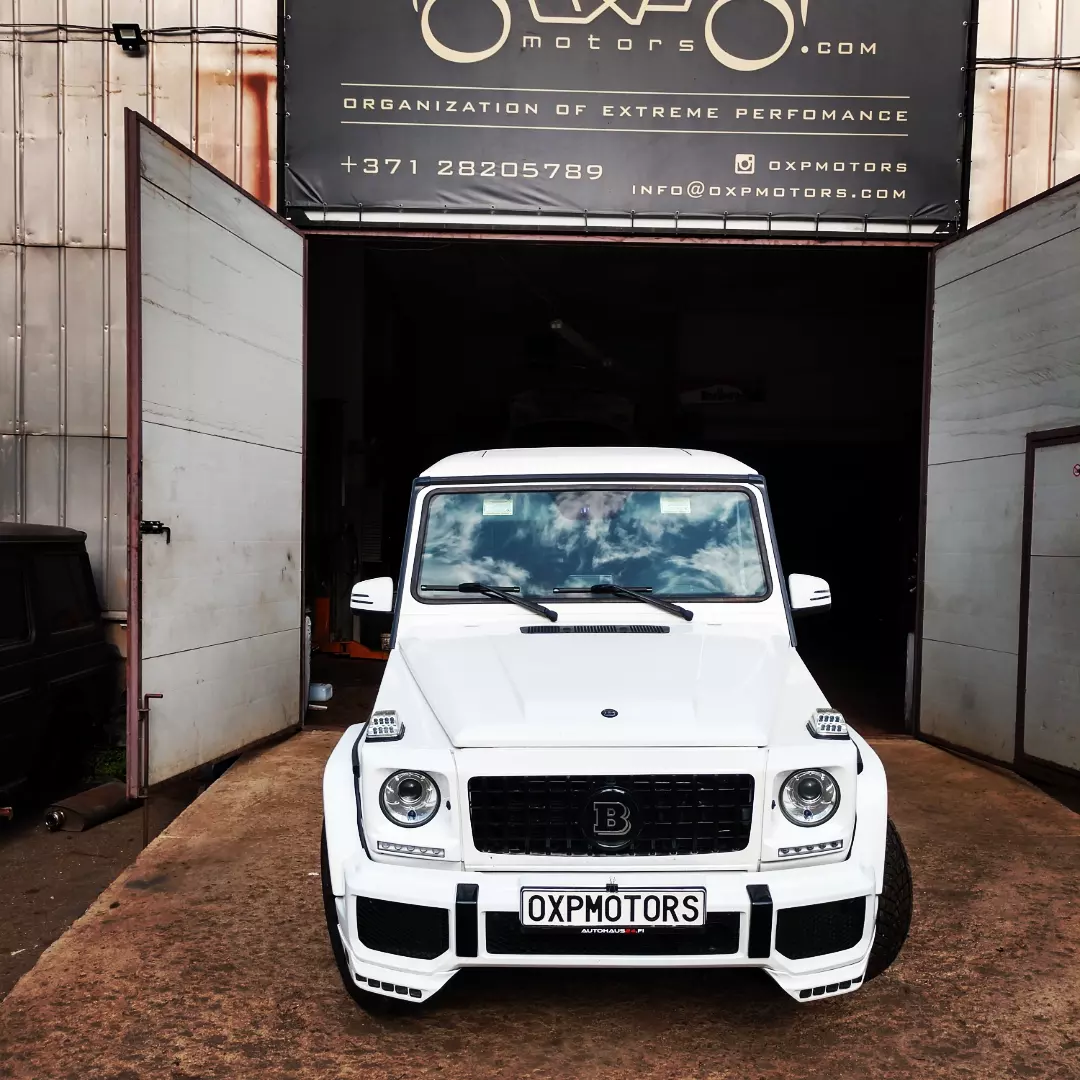
OXPmotors is a Mercedes-Benz G-Class specialist workshop in Riga, Latvia. We work on W460 and W463 models – restoration, mechanical repair, rebuilds, and everything in between. If your G-Class needs attention, get in touch.